俄罗斯挂科送去战场?跨国家庭的子女教育焦虑与突围之路
 中创侨智
中创侨智 
Identification of Foreign High-Level Talents in Guangdong Province

“挂科就送去战场”——近期,俄罗斯乌拉尔联邦大学的部分学生面临着一个艰难选择:要么被学校清退,要么与国防部签订军事合同,加入前线的“特别军事行动”。
"Failing exams means being sent to the battlefield" — Recently, some students at Russia's Ural Federal University are facing a difficult choice: either be expelled from the university or sign a military contract with the Ministry of Defense to join the frontline "special military operation".
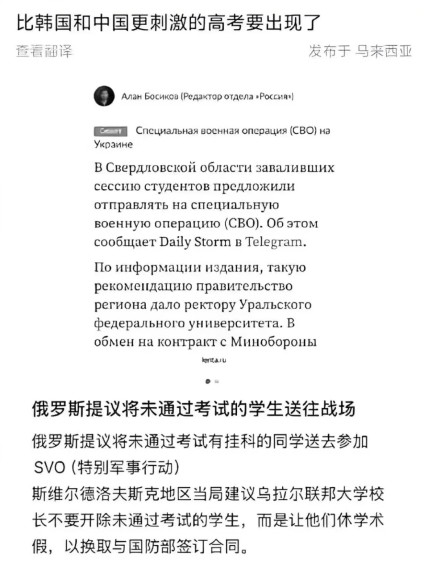
这则消息在网上迅速传播,虽后被澄清并非强制性措施,但仍引发广泛关注。
The news spread rapidly online, and although it was later clarified that it was not a mandatory measure, it still attracted widespread attention.

教育压力与生存危机
Educational pressure and survival crisis

俄罗斯高校的“挂科送战场”事件虽未被最终确认,却折射出一些国家教育体系的特殊压力。据俄媒报道,不仅是乌拉尔联邦大学,整个斯维尔德洛夫斯克州的大学都收到了州教育部的类似函件。
Although the incident of "failing exams and being sent to the battlefield" in Russian universities has not been finally confirmed, it reflects the special pressures on the education systems of some countries. According to Russian media reports, it is not only Ural Federal University, but also all universities in the Sverdlovsk Oblast that have received similar letters from the regional Ministry of Education.

中创侨智觉得这一提案指向一个严峻现实——教育直接关联生存选择。
OTGEO believes that this proposal points to a severe reality - education is directly related to survival choices.
当一些国家的学生因教育问题面临极端命运时,越来越多中外结合家庭却在为子女的教育规划而奔波。他们试图在全球化的教育体系中寻找最佳路径,以应对日益激烈的教育竞争。
While students in some countries face extreme fates due to educational issues, an increasing number of Chinese-foreign mixed families are busy planning their children's education. They are trying to find the best path in the global education system to cope with the increasingly fierce educational competition.

中外家庭的困境
The Dilemmas of Chinese-Foreign Mixed Families

当 “考试压力” 成全球共鸣,中外结合家庭的孩子,正面临更复杂的 “双重夹击”。中创侨智分析得出以下结论:
身份尴尬的升学壁垒:无中国永居的外籍子女难享本地高考配额,回国升学需与千万考生同台竞技;持外籍身份却因成长于国内,缺乏海外教育背景,申请国外名校无优势。
标准撕裂的能力要求:既要适应国内基础教育的高强度刷题,又要应对外籍身份所需的语言认证(如 HSK 汉语考试),陷入 “两边都要抓,两边都不精” 的困境。
成本失控的路径迷茫:国际学校年均 30 万学费掏空积蓄,回国高考又因教材差异 “水土不服”,不少家庭在 “留学还是高考” 间反复内耗。
When "exam pressure" resonates globally, children from Sino-foreign mixed families are facing a more complex "double squeeze". OTGEO has analyzed and drawn the following conclusions:
Barriers to further education with an awkward identity:
Foreign children without permanent residence in China cannot enjoy the local college entrance examination quotas. If they return to China for further education, they have to compete with millions of examinees. Those with foreign nationality, having grown up in China and lacking an overseas educational background, have no advantages when applying for prestigious foreign universities.
Conflicting standards for ability requirements:
They have to adapt to the intensive question-practicing in domestic basic education and cope with language certifications required for foreign nationality (such as the HSK Chinese proficiency test), falling into the dilemma of "having to grasp both sides but not being proficient in either".
Uncontrollable costs and confused paths:
Annual tuition fees of 300,000 yuan for international schools drain savings. Returning to take the college entrance examination leads to "acclimatization" due to differences in teaching materials. Many families are trapped in repeated internal conflicts over "studying abroad or taking the college entrance examination".

跳出内卷的身份红利
Breaking Out of the Identity Dividend in the Involution

面对国内外教育竞争的压力,一些跨国家庭开始利用政策红利,为子女寻找更有利的入学路径。外籍生考试、华侨生联考等特殊渠道,成为他们关注的焦点。
Faced with the pressure of educational competition both domestically and internationally, some transnational families have begun to take advantage of policy dividends to find more favorable admission paths for their children. Special channels such as foreign student examinations and the Joint College Entrance Examination for Overseas Chinese Students have become the focus of their attention.
教育部的两类特殊招生政策,正成为中外家庭的 “破局关键”,但需精准匹配身份场景,中创侨智推荐:
The two types of special admission policies of the Ministry of Education are becoming the "key to breaking the situation" for both Chinese and foreign families. However, they need to accurately match the identity scenarios. OTGEO recommends:
(一)外籍生通道:拿 “国际学生证” 敲开名校门
适合群体:孩子持外国国籍的家庭
✅ 核心优势:
免高考:通过高校自主招生考试(多为面试 + 基础笔试)即可录取,如清华外籍生考试仅考汉语、数学、英语三科。
低门槛:部分 985 高校对外籍生的 HSK 汉语水平要求仅为 5 级(相当于中级水平),远低于高考难度。
⚠️ 2025 年政策红线:
需提供 “最近 4 年在境外实际居住 2 年以上” 证明,杜绝 “国内读书 + 外籍身份” 的空壳操作,中介伪造的居住证明已无法通过核查。
(1) International Student Channel: Use the "International Student ID" to open the door to top universities
Suitable group: Families where the child holds foreign nationality
✅Core advantages:
No need for the college entrance examination: Admission can be obtained through the university's independent enrollment examination (mostly interviews + basic written tests). For example, Tsinghua University's international student examination only covers three subjects: Chinese, mathematics, and English.
Low threshold: Some 985 universities only require international students to have an HSK (Chinese Proficiency Test) level 5 (equivalent to intermediate level), which is much lower than the difficulty of the college entrance examination.
⚠️2025 Policy Red Line:
Need to provide proof of "actually residing abroad for more than 2 years in the recent 4 years" to eliminate the empty operation of "studying in China + foreign nationality". Residence certificates forged by intermediaries can no longer pass the verification.
(二)华侨生联考:用 “海外居留权” 换低分入场券
适合群体:父母一方获海外永居、孩子保留中国国籍的中外家庭
✅ 碾压式优势对比
高考倒计时1天——2025高考数据:1335万考生争450万本科名额
⚠️ 身份认定硬标准:
1.父母一方需取得海外永居,且近 2 年累计居留满 18 个月;
(2) Overseas Chinese Student Joint Examination: Using "overseas residency rights" to obtain a low-score admission ticket
Suitable groups: Chinese-foreign families where one parent has obtained overseas permanent residency and the child retains Chinese nationality
✅Overwhelming advantage comparison
高考倒计时1天——2025高考数据:1335万考生争450万本科名额
⚠️Hard standards for identity recognition:
1. One of the parents must have obtained overseas permanent residency and have resided overseas for a cumulative period of 18 months in the past 2 years;
2. The child himself/herself must have actually resided overseas for 18 months in the past 2 years (study abroad and official residency are not included);
3. It is necessary to provide residency certificates and kinship documents certified by overseas embassies or consulates.
3年规划时间表 + 风险预警 3-Year Plan Timeline + Risk Early Warning 黄金准备期(初中阶段) Gold Preparation Period (Junior High School Stage) Grade 7 and Grade 8: Determine the path — Foreign students need to plan their overseas residence records; overseas Chinese students need to initiate their parents' permanent residency applications (such as Malta permanent residency, which is approved within 6-8 months and can meet the residency requirements/Greek permanent residency). Grade 9: Supplement materials — Overseas Chinese students and foreign students need to have overseas high school enrollment status and keep their report cards; foreign students need to prepare for the HSK proficiency test as a foundation. 常见踩坑点 居住记录造假:2025 年起海关数据与教育部联网,短期出国 “刷居留” 或被直接驳回。 混淆 “永居” 与 “国籍”:华侨生需保留中国国籍,拿外籍后不可再参与华侨生联考。外籍生不可存在中国国籍,如有不可参加国内外籍生考试。 忽视附加成本:华侨生规划需承担海外房租(如马耳他两居室约 1200 欧 / 月),需提前做资金规划。

Common pitfalls
Falsification of residence records: Starting from 2025, customs data will be connected to the Ministry of Education, and short-term overseas "residence brushing" may be directly rejected.
Confusing "permanent residence" with "nationality": Overseas Chinese students need to retain Chinese nationality; those who obtain foreign nationality can no longer participate in the Overseas Chinese Student Joint Entrance Examination. Foreign students must not have Chinese nationality; if they do, they cannot take the foreign student entrance examination in China.
Neglecting additional costs: Planning for overseas Chinese students requires bearing overseas rent (for example, a two-bedroom apartment in Malta is about 1200 euros per month), so financial planning needs to be done in advance.
The essence of a shortcut lies in "advance planning". From Russia's "exam anxiety" to China's "educational involution in升学", the nature of educational competition has never changed. However, the unique status of Chinese and foreign families precisely provides a window of policy dividends. Neither the foreign student channel nor the Overseas Chinese Student Joint Examination is a shortcut to "buying a degree with money", but rather wisdom of "exchanging planning for opportunities". After all, a true breakthrough in further education is never about fabricating identities at the last minute, but about compliant planning and capacity building 3-6 years in advance. Learning, growing, and adapting in the gap between different cultures, educational competition never stops; it just shifts the battlefield.
财经号声明: 本文由入驻中金在线财经号平台的作者撰写,观点仅代表作者本人,不代表中金在线立场。仅供读者参考,并不构成投资建议。投资者据此操作,风险自担。同时提醒网友提高风险意识,请勿私下汇款给自媒体作者,避免造成金钱损失,风险自负。如有文章和图片作品版权及其他问题,请联系本站。
